
 Newsroom

- Photonics
5 Oct 2026
5 questions to Dr. Henri Porte, pioneer of the lithium-niobate electro-optical modulation, former CEO Photonics at Exail
Henri Porte was a senior researcher at FEMTO ST lab in Besançon, where he developed the lithium niobate electro-optical technology in the 1980's. He then pioneered its industrialization within Exail since 2000. It is now a core component for fiber-optic-gyroscope technology, for which Exail is a leading manufactured worldwide, and for many other critical applications in high-power laser, space, sensing and quantum technology.

" Made by Exail in Besançon, the optical modulator embodies a rare technological know-how: the ability to guide and control light with extreme precision. "
What has been the core advantage of lithium-niobate electro-optical modulator technology?
Lithium-niobate electro-optical modulator technology has been a cornerstone for modern high-speed fiber optic telecommunications, leveraging the unique properties of lithium-niobate (LiNbO₃) crystals. These crystals exhibit exceptional electro-optic efficiency, enhanced by the Pockels effect, where the material's refractive index changes in response to an applied electric field. This allows precise modulation of light, crucial for high-bandwidth data transmission.
These properties enable the efficient conversion of electrical signals into optical ones, with minimal losses. The high electro-optic efficiency and fast switching times (on the order of picoseconds) allow for the modulation of intense optical signals, supporting data rates of several tens of Gb/s per wavelength channel.

Which were the 3 main technological steps towards the manufacturing of electro-optical modulators?
The manufacturing of electro-optical modulators based on lithium-niobate (LiNbO₃) has evolved through three key technological steps:
Metallic Diffusion
The first major advancement was the metallic diffusion within the lithium-niobate, which introduced a guiding layer beneath the crystal surface. The waveguide confines the light into a small cross-sectional area (around 10 μm²), enhancing the interaction between the light and the electro-optical material. This confinement allows the light to propagate through total internal reflections, dramatically improving modulation efficiency compared to free-space propagation.
Electro-Optical Interaction
The second technological step focuses on applying an electric field across the lithium-niobate crystal. The material's refractive index changes according to the Pockels effect, modulating the phase of the light passing through. The waveguide configuration greatly amplifies this interaction, enabling efficient phase modulation with lower control voltages and improving the modulator's performance over long interaction distances.
Electro-Optical Bandwidth
The final step involves optimizing the modulator’s bandwidth. By fine-tuning the geometry of the waveguide and the electrode design, including the use of microwave lines with precise phase and impedance matching, lithium-niobate modulators can achieve bandwidths that span from the microwave (300 MHz) to the millimeter-wave frequency range (up to 300 GHz).

What is the current manufacturing process?
The manufacturing of lithium-niobate electro-optical modulators combines wafer-scale microfabrication in cleanroom conditions with high-precision optical and RF packaging. The process can be divided into three main stages:
Design
At wafer level, optical waveguides are produced mainly using two established technologies: titanium diffusion and Annealed Proton Exchange (APE). Titanium diffusion creates a local increase in refractive index by thermally diffusing titanium into the lithium-niobate crystal. It provides highly stable waveguides, particularly at telecom wavelengths above 1,300 nm. APE relies instead on a controlled chemical proton-exchange process followed by thermal annealing. It guides essentially one polarization state and therefore provides an intrinsically high polarization extinction ratio, while also offering improved resistance to photorefractive effects at shorter wavelengths. In return, APE requires particularly tight control of the fabrication parameters to ensure reproducibility.
Integration
The photonic circuits and microwave electrodes are fabricated on 3- to 6-inch LiNbO₃ wafers in cleanrooms, using micro-photolithography, thin-film deposition, thermal diffusion and several successive mask-alignment steps. Feature sizes are typically on the micrometer scale, with sub-micrometer process tolerances. Crystal orientation—most commonly X-cut or Z-cut—is selected according to the targeted electro-optic interaction and electrode architecture. For high-frequency modulators, substrate thickness is also a critical parameter: wafers are typically thinned to around 500 µm or less to suppress unwanted dielectric substrate modes and preserve electro-optical bandwidth beyond several tens of gigahertz. Once processing is complete, the wafer is diced into individual chips and their optical facets are precisely polished.
Packaging
Packaging is itself a critical part of modulator performance. Input and output optical fibers must first be accurately aligned and permanently attached to the waveguides with very low coupling loss. The chip is then mounted in a metallic package, typically stainless steel or Kovar, equipped with high-performance microwave connectors, DC bias connections and, where required, monitoring photodiodes. Thermal-expansion mismatches between lithium niobate, silica fibers and the metallic housing must be carefully managed to prevent mechanical stress over temperature cycles. Packages may be hermetically sealed and are generally gold plated to facilitate soldering and welding operations. The completed modulator then undergoes final optical, electrical and RF characterization to verify insertion loss, extinction ratio, drive voltage, electro-optical bandwidth and environmental robustness.

What are the main ranges of electro-optical modulators?
Lithium-niobate electro-optical modulators have evolved into several major product families, each exploiting the Pockels effect in a different optical architecture. Together, they address applications ranging from high-speed optical communications and microwave photonics to precision inertial navigation.
Intensity modulators
In Mach-Zehnder intensity modulators, light is split into two guided arms, modulated through RF traveling-wave electrodes, and then recombined interferometrically to convert an electrically induced phase shift into intensity modulation. Key performance parameters include half-wave voltage, electro-optical bandwidth, extinction ratio, insertion loss and chirp.
Phase modulators and I/Q modulators
A phase modulator directly changes the optical phase through the Pockels effect.
An I/Q modulator—typically implemented as a dual-parallel Mach-Zehnder structure—combines two nested Mach-Zehnder modulators with controlled relative phase. It can also generate functions such as carrier-suppressed single-sideband modulation for microwave photonics and analog optical signal processing.
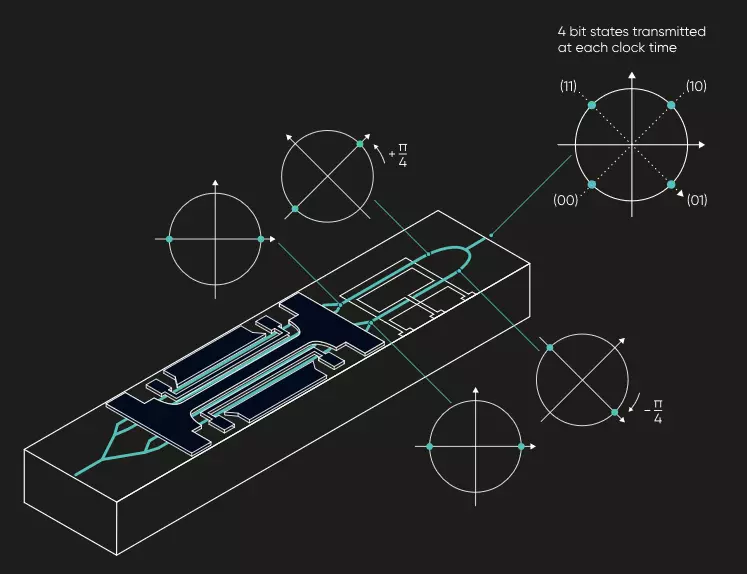
Simultaneous integration of the phase and amplitude modulation functions into one unique component, the MXIQER, optical IQ modulator
Polarization modulators
Polarization modulators exploit less commonly used coefficients of the lithium-niobate electro-optic tensor to dynamically control the state of polarization. By propagating along an appropriate crystal axis and applying orthogonal electric fields, the device can transfer optical power between Transverse Electric (TE) and Transverse Magnetic (TM) modes, rotate linear polarization, or behave as an electrically tunable half-wave or quarter-wave plate. This enables fast, all-electronic polarization switching and continuous polarization control without moving parts.
Integrated Optical Circuit (IOC)
The IOC is a LiNbO₃ component that integrates several optical functions on a single chip: input polarization, 1×2 splitting, differential phase modulation and spatial filtering.
APE waveguides provide very high polarization rejection, while a push-pull electrode configuration applies opposite phase shifts to the two arms. Connected to a polarization-maintaining fiber coil, the IOC forms the active electro-optical element of the Sagnac interferometer at the heart of a Fiber-Optic Gyroscope, where low drive voltage, excellent linearity, single-mode behavior and long-term stability directly determine inertial-sensor performance.
Key markets for today electro-optical modulation technology?
Today, the market for lithium-niobate electro-optical modulators extends well beyond their historical role in telecom networks. Their combination of fast and highly linear phase control, high extinction ratio, low insertion loss, high optical-power handling and polarization control makes them particularly valuable wherever a laser must be manipulated with very high fidelity.
" A technology we started developing decades ago in Besançon is now enabling critical photonic systems all around the world. "
High-power fiber lasers
They are a major application for phase modulation, particularly for spectral broadening.
As power is increased through successive fiber-amplifier stages, narrow-linewidth lasers become limited by Stimulated Brillouin Scattering (SBS), which sends part of the optical energy backward and limits the achievable output power. A LiNbO₃ phase modulator driven by sinusoidal, multitone, noise or PRBS electrical signals deliberately broadens the seed laser spectrum over several GHz, lowering its spectral power density and consequently raising the SBS threshold.
This function is central to kilowatt-class fiber lasers and coherent or spectral beam-combining architectures, where low Vπ, high optical-power handling and an electro-optical bandwidth matched to the desired broadening spectrum become critical specifications.

Fiber-pigtailed multichannel lithium-niobate waveguide chip.
Quantum communications
Quantum Key Distribution (QKD) creates another particularly demanding market because the optical states must be generated with extremely high fidelity. In discrete-variable QKD, high-extinction-ratio Mach-Zehnder intensity modulators can generate well-defined optical pulses and decoy levels while minimizing residual light between nominally extinguished states; electro-optic phase and polarization control can then encode information onto phase, time-bin or polarization degrees of freedom. Polarization encoding, in particular, benefits from the fast, deterministic control possible with LiNbO₃ electro-optics. For continuous-variable QKD, I/Q modulators simultaneously control the two optical quadratures, enabling coherent amplitude-and-phase state preparation. In all cases, high extinction ratio, low insertion loss, polarization purity and stable Vπ are especially important because imperfections can directly degrade the quantum-state preparation and ultimately the achievable key rate.
Quantum sensing and computing
Quantum technologies also depend increasingly on electro-optic modulation through ultra-stable laser systems. A representative application is the Pound–Drever–Hall (PDH) technique—a classical laser-stabilization technique that is an enabling technology for many quantum experiments. A LiNbO₃ phase modulator generates RF sidebands around the optical carrier before the light interacts with a high-finesse reference cavity. Detection and synchronous demodulation of the reflected signal produce an error signal that can be fed back to the laser, locking its optical frequency to the cavity resonance and strongly suppressing frequency noise. Such narrow-linewidth, frequency-stable lasers are essential for applications including atom cooling and manipulation, atomic spectroscopy, optical clocks, neutral-atom and ion-based quantum systems, and quantum sensing.

Precision sensing
This fourth major field of application encompasses LiDAR, laser metrology and distributed fiber sensing. In pulsed and FMCW LiDAR, intensity and phase modulators provide precise pulse shaping, frequency or phase modulation, improving ranging resolution and coherent detection capabilities. Laser trackers similarly exploit fast phase and intensity control for high-precision measurements of moving targets. In distributed fiber sensors such as BOTDA-based Distributed Temperature Sensing (DTS), high-extinction-ratio modulators generate well-defined probe or pump pulses and optical sidebands, while polarization scramblers help reduce polarization-dependent measurement errors; related modulation functions are also used in Distributed Acoustic Sensing (DAS). The same ability to impose extremely precise phase information is now extending electro-optic modulation into advanced laser metrology—for example, the LiNbO₃ phase modulators selected for LISA will encode clock-transfer, ranging and telemetry information onto its interferometric laser beams.


